
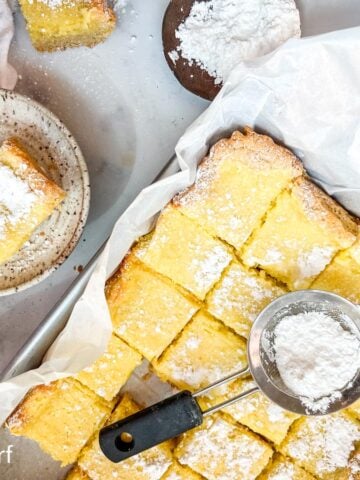
If you’ve ever wandered into a Philadelphia bakery, you’ve probably experienced the smell of freshly baked German Butter Cake: yeast, butter and sugar dusted with powdered sugar.
This dessert has a soft and fluffy base covered with a gooey, buttery topping, similar to a danish. Some compare it to St. Louis Gooey Butter Cake (cake mix version) and Missouri Gooey Butter Cake (from scratch)
Whether you’re baking for brunch, the holidays, or just because, this Philadelphia German butter cake is comfort on a plate.
This is a plan ahead dessert, the dough needs to rise for an hour before you coat it with the butter layer and bake it.
The base of the cake has to proof for at least an hour and while it's rising, you'll make the butter topping.

Jump to:
Advice Before You Start this Recipe
There are two main steps to making German butter cake.
Make the yeast cake base, which has to proof for an hour.
While the cake is rising, make the butter topping.
Then you'll spread the butter layer on top and bake the cake.
Special Ingredients Needed
There are three ingredients you may not keep in your pantry:
- Yeast (active, dry, one packet)
- Superfine sugar (also known as caster sugar, you can make it yourself by blitzing granulated sugar in your food processor for 20 to 30 seconds.)
- Shortening (I use a half stick of Crisco)
Make Philly Butter Cake Base
Mix sugar, shortening, and salt in a large mixing bowl. Add egg and beat 1 minute.
Stir yeast into warm milk. Add flour, milk/yeast mix, and vanilla to dough; mix 3 minutes. Knead briefly, cover with a linen cloth then let rise for 1 hour.
Divide dough into two 8-inch pans or one 9x13-inch pan. Press to fit and crimp edges. Prick with fork,
Make butter topping and spread over the top with a rubber spatula or an offset spatula.
Bake at 375°F for 30 minutes. Topping should be crusty on top, gooey underneath.
Cool cake before cutting.
Not sure what your dough should look like? Or how gooey the topping really gets?
Let me show you. The photos below walk you through it all.


Add the yeast, milk and flour and stir.


Make butter layer while cake is proofing.


Recipe Notes
If your dough doesn't rise, keep going. The cake will still be okay and delish just not as fluffy.
Working with Yeast
I unwittingly killed my yeast by overheating the milk. So my dough didn't double in size while proofing. But it still had that warm, bakery yeasty deliciousness.
Warm the milk to a temperature between 100°F and 110°F. Use a good thermometer to gauge how warm it is.
I use this digital thermometer and love it because it's quick, accurate and there's a light for my aging eyesight. (affiliate link)
Also, because I don't work with yeast very often I'm not sure about this but my house was pretty cool that day.
I had all the windows open and it was a 60F° degree day here with a strong wind.
I've always heard that you need a warm place to let baked goods proof.
But you'll make the cake the right because you'll heat your milk to the proper temperature--between 100°F and 110°F and the yeast will activate properly instead of overheating and dying.
Another mistake I made--I put the yeast in the bowl and poured the milk over the top. So most of the yeast granules ended up stuck to the bottom of the bowl.
Sprinkle the package of active dry yeast over the warm milk and whisk until dissolved.

Kneading the Dough
Choose between kneading by hand or using the dough hook in your stand mixer.
I chose the hook, which by some miracle I found with in just a few moments of searching even though I'd tucked it away in the back of my baking cabinet because I never use it.
The dough is easy to work with and you'll know it's done when it pulls away from the mixing bowl and clings to the hook.
You'll still need to turn the dough onto a floured board and knead it by hand for a minute after you're done with the dough hook before covering it with a cloth and letting it rise for an hour.
Butter Layer Notes
The butter layer uses superfine sugar, which is sometimes called extra fine sugar or caster sugar.
This has smaller sugar crystals than granulated sugar but not so fine as to be confectioner's sugar.
The smaller crystals dissolves more easily into cake batter or meringue batter than regular size granulated sugar crystals.
Brands sell superfine sugar but you can make your own by blitzing it in a food process for 30 or so seconds.

Pin to Save for Later

Want to Save This Recipe?
Enter your email & I'll send it to your inbox. Plus, get great new recipes from me every week!
By submitting this form, you consent to receive emails from Kitchen Serf.
Recipe
Philadelphia German Butter Cake Recipe

This old-school Philadelphia German butter cake is rich, soft, and yeasty with a gooey, buttery topping. An easy homemade version of the bakery classic!
Ingredients
- Cake Layer
- ¼ cup granulated sugar
- ¼ cup hydrogenated shortening (Crisco)
- ⅛ teaspoon salt
- 1 large egg
- 1 envelope active dry yeast
- ½ cup warm milk
- 2 ½ cups all-purpose flour
- 1 tablespoon vanilla extract
- Butter Cake Topping:
- ½ pound (2 sticks) unsalted butter
- ½ cup flour
- 2 cups extra-fine sugar
- 2 extra large eggs
- 4 to 5 tablespoons milk
Instructions
Prepare dough by mixing sugar with shortening and salt.
Add egg and beat with mixer one minute until well-blended.
Dissolve yeast in warm milk.
Add flour, then milk-yeast mixture and vanilla to dough batter.
Mix three minutes with dough hook or by hand.
Turn dough onto floured board; knead one minute.
Place in lightly greased bowl, cover with a towel and allow to rise for one hour or until doubled. Meanwhile, prepare topping; set aside.
Divide dough in two pieces. Roll or pat to fit two well-greased 8-inch-square pans or one 9- by 13- by 2-inch pan.
Crimp edges halfway up sides of pan to hold topping in. When dough is spread, prick dough with fork to prevent bubbling.
Make Butter Cake Topping
Cream butter.
Stir together flour and superfine sugar.
Gradually beat sugar mixture into butter.
Add eggs, one at a time, beating well after each addition.
Spread topping over dough.
Bake at 375°F for 30 minutes or until done. Do not overbake. Topping should be crusty but gooey. Let cool before cutting.
Notes
If your dough doesn’t rise, don’t worry—it’ll still taste great, just less fluffy.
Be sure to warm the milk to 100°F–110°F before adding yeast. Too hot, and you’ll kill it.
Sprinkle the yeast over the milk and whisk to dissolve—don’t pour milk over the yeast or it may clump.
You can knead the dough by hand or with a mixer dough hook, but give it a quick hand knead at the end before letting it rise.
For the butter topping, use superfine sugar or make your own by pulsing granulated sugar in a food processor for 30 seconds.
You might also like Gooey Butter Cake (Cake Mix Recipe)
Nutrition Information
Yield 24 Serving Size 1Amount Per Serving Calories 189Total Fat 4gSaturated Fat 2gTrans Fat 0gUnsaturated Fat 3gCholesterol 34mgSodium 42mgCarbohydrates 34gFiber 0gSugar 22gProtein 3g
Nutrition information is an estimate as I am not a registered dietician.



Comments
No Comments